connections.h File Reference
#include <netinet/in.h>#include <signal.h>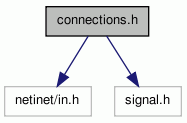
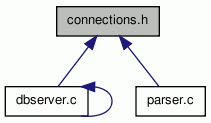
Go to the source code of this file.
Defines | |
| #define | DBPORT 9000 |
| #define | MAXBUFLEN 2000 |
Functions | |
| void | setup () |
| void | DB_udp () |
| void * | DB_udphandler (void *udp_BUF) |
| void | DB_process_UDP (unsigned char *udp_BUF) |
Variables | |
| int | DB_sockfd |
| struct sockaddr_in DB_server_addr | their_addr |
| int | DB_addr_len |
| int | numbytes |
| unsigned char | buffer [MAXBUFLEN] |
Define Documentation
| #define DBPORT 9000 |
Definition at line 37 of file connections.h.
Referenced by setup().
| #define MAXBUFLEN 2000 |
Definition at line 38 of file connections.h.
Referenced by DB_udp().
Function Documentation
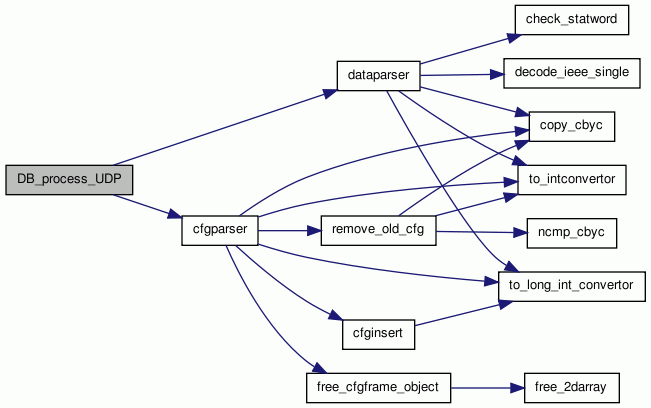
| void DB_process_UDP | ( | unsigned char * | udp_BUF | ) |
Definition at line 245 of file connections.c.
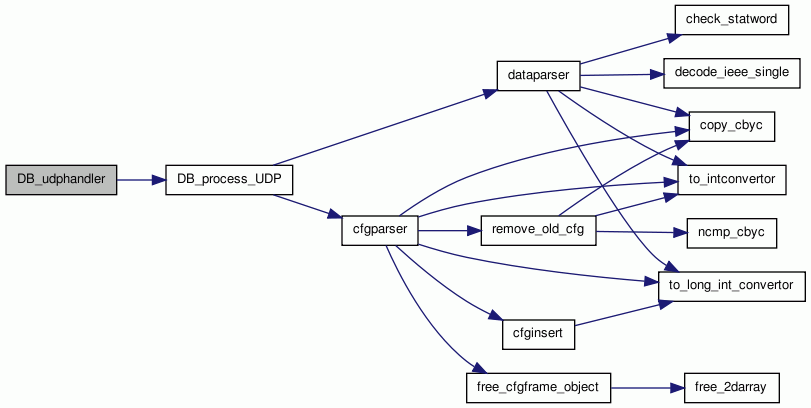
References cfgparser(), and dataparser().
Referenced by DB_udphandler().
00245                                            {
00246
00247         int stat_status,i;
00248         unsigned char c = udp_BUF[1];
00249         c <<= 1;
00250         c >>= 5;
00251         if(c == 0x00){                                  /* If data frame */
00252
00253                 printf("\nData frame\n");
00254                 stat_status = dataparser(udp_BUF);
00255                 printf("Return from DParser\n");
00256
00257         } else if(c == 0x03) {                  /* If configuration frame */
00258
00259                 for(i=0;i<400;i++)printf("%x\t",udp_BUF[i]);
00260                 printf("\nConfiguration frame\n");
00261                 cfgparser(udp_BUF);
00262                 printf("Return from CFG\n");
00263
00264
00265         } else {
00266
00267                 printf("Erroneous frame\n");
00268
00269         }
00270         fflush(stdout);
00271 }

| void DB_udp | ( | ) |
Definition at line 160 of file connections.c.
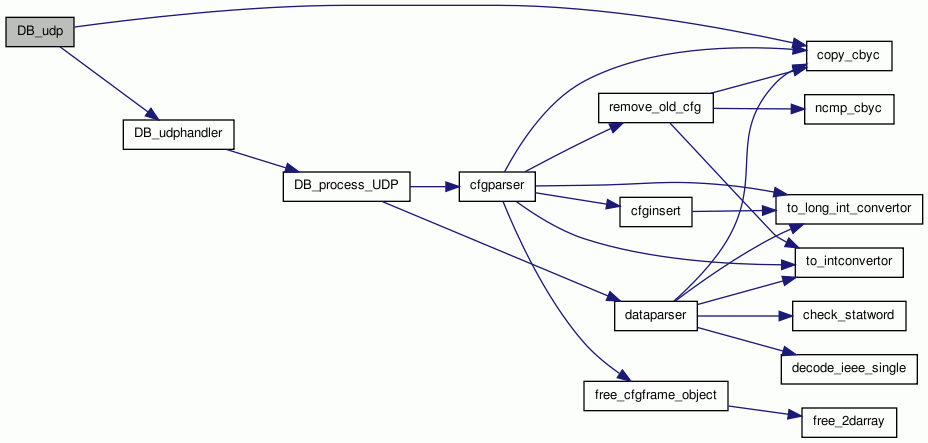
References buffer, copy_cbyc(), DB_addr_len, DB_sockfd, DB_udphandler(), MAXBUFLEN, mutex_on_buffer, numbytes, and their_addr.
Referenced by setup().
00160              {
00161
00162         // UDP threads are created for each received UDP message in 'detached' mode. Thus allowing any number of threads to be created.
00163         int err;
00164         pthread_attr_t attr;
00165         pthread_attr_init(&attr);
00166
00167         if((err = pthread_attr_setdetachstate(&attr, PTHREAD_CREATE_DETACHED))) { // In  the detached state, the thread resources are
00168                                                                                 // immediately freed when it terminates, but
00169                 perror(strerror(err));                                          // pthread_join(3) cannot be used to synchronize
00170                 exit(1);                                                        //  on the thread termination.
00171
00172         }
00173
00174         if((err = pthread_attr_setschedpolicy(&attr,SCHED_FIFO))) { // Shed policy = SCHED_FIFO (realtime, first-in first-out)
00175
00176                 perror(strerror(err));
00177                 exit(1);
00178         }
00179
00180
00181         /* UDP data Received */
00182         while(1) {
00183
00184                if ((numbytes = recvfrom(DB_sockfd,buffer, MAXBUFLEN-1, 0,(struct sockaddr *)&their_addr, (socklen_t *)&DB_addr_len)) == -1) {
00185                                                                                                         // Main if
00186                          perror("recvfrom");
00187                          exit(1);
00188
00189                 } else { /* New datagram has been received */
00190
00191                         pthread_t t;
00192                         int tt;
00193                         unsigned char *udp_BUF;
00194                         udp_BUF = malloc(MAXBUFLEN*sizeof(unsigned char));
00195
00196                         if(!udp_BUF) {
00197
00198                                 printf("No space for udp_BUF\n");
00199                                 exit(1);
00200                         }
00201                         printf("\nUDP Server got packet from %s\n",inet_ntoa(their_addr.sin_addr));
00202                         printf("packet is %d bytes long\n",numbytes);
00203                         buffer[numbytes] = '\0';
00204
00205                         /* Copy the udp_buf data to a local variable */
00206                         pthread_mutex_lock(&mutex_on_buffer);
00207                         copy_cbyc(udp_BUF,buffer,MAXBUFLEN);
00208                         memset(buffer, '\0', MAXBUFLEN);
00209                         pthread_mutex_unlock(&mutex_on_buffer);
00210
00211                         /* Creates a new thread for each received UDP message */
00212                         if((tt = pthread_create(&t,&attr,DB_udphandler,(void *)udp_BUF))) {
00213
00214                                 perror(strerror(tt));
00215                                 exit(1);
00216                         }
00217
00218                 } // Main if ends
00219
00220          } // while ends
00221
00222          pthread_attr_destroy(&attr);
00223 }

| void* DB_udphandler | ( | void * | udp_BUF | ) |
Definition at line 230 of file connections.c.
References DB_process_UDP().
Referenced by DB_udp().
00230                                     {
00231
00232         DB_process_UDP((unsigned char*)udp_BUF);
00233
00234         free((unsigned char*)udp_BUF);
00235
00236         pthread_exit(NULL); /* Exit the thread once the task is done. */
00237
00238 }

| void setup | ( | ) |
Definition at line 68 of file connections.c.
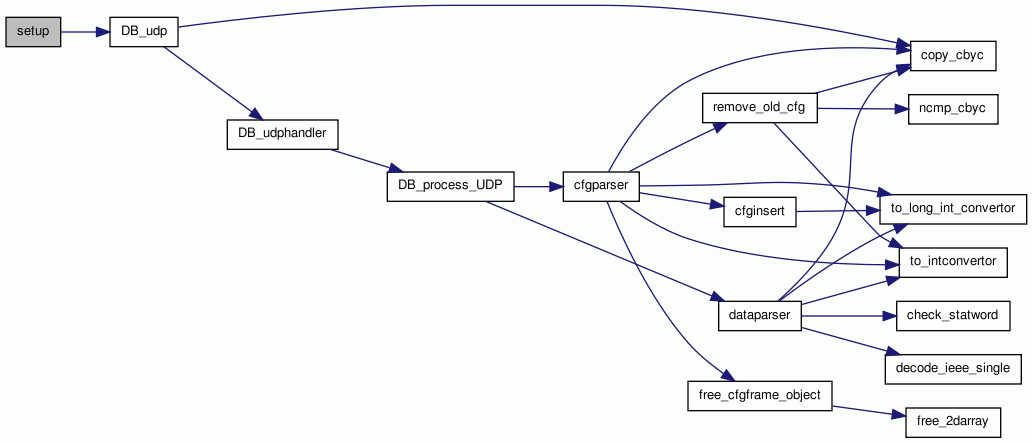
References conn_cfg, conn_data, database, DB_addr_len, DB_sockfd, DB_udp(), DBPORT, password, server, and user.
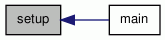
Referenced by main().
00068             {
00069
00070         printf("Entering setup()\n");
00071
00072 /* MySQL data base parameters */
00073
00074         server = "localhost";
00075         user = "root";
00076         password = "root";
00077         database = "openPDC";
00078
00079 /* MySQL data base connection */
00080
00081         conn_data = mysql_init(NULL);
00082         conn_cfg = mysql_init(NULL);
00083
00084         if(conn_data == NULL) {
00085
00086                 printf("No sufficient memory\n");
00087                 exit(1);
00088         }
00089
00090         if(conn_cfg == NULL) {
00091
00092                 printf("No sufficient memory\n");
00093                 exit(1);
00094         }
00095
00096 /* Connect to database */
00097         if (!mysql_real_connect(conn_data, server,
00098                       user, password, database, 0, NULL, 0)) {
00099
00100                 fprintf(stderr, "%s\n", mysql_error(conn_data));
00101                 exit(1);
00102         }
00103
00104         if (!mysql_real_connect(conn_cfg, server,
00105                       user, password, database, 0, NULL, 0)) {
00106
00107                 fprintf(stderr, "%s\n", mysql_error(conn_cfg));
00108                 exit(1);
00109         }
00110
00111 /* Create UDP socket and bind to port */
00112         int yes;
00113         if ((DB_sockfd = socket(AF_INET, SOCK_DGRAM, 0)) == -1) {
00114
00115                  perror("socket");
00116                  exit(1);
00117
00118         } else {
00119
00120                 printf("DB Socket:Sucessfully created\n");
00121
00122         }
00123
00124         if (setsockopt(DB_sockfd,SOL_SOCKET,SO_REUSEADDR,&yes,sizeof(int)) == -1) {
00125                 perror("setsockopt");
00126                 exit(1);
00127         }
00128
00129         DB_server_addr.sin_family = AF_INET;            // host byte order
00130         DB_server_addr.sin_port = htons(DBPORT);        // short, network byte order
00131         DB_server_addr.sin_addr.s_addr = INADDR_ANY;    // automatically fill with my IP
00132         memset(&(DB_server_addr.sin_zero),'\0', 8);     // zero the rest of the struct
00133
00134         if (bind(DB_sockfd, (struct sockaddr *)&DB_server_addr,
00135                                      sizeof(DB_server_addr)) == -1) {
00136                  perror("bind");
00137                  exit(1);
00138
00139         } else {
00140
00141                 printf("DB Socket Bind :Sucessfull\n");
00142         }
00143
00144         printf("\nDB Server Listening on port %d\n",DBPORT);
00145
00146         DB_addr_len = sizeof(struct sockaddr);
00147
00148         DB_udp();
00149         mysql_close(conn_cfg);
00150         mysql_close(conn_data);
00151
00152 }
Variable Documentation
| unsigned char buffer[MAXBUFLEN] |
Definition at line 43 of file connections.h.
Referenced by DB_udp().
| int DB_addr_len |
Definition at line 42 of file connections.h.
| int DB_sockfd |
Definition at line 40 of file connections.h.
| int numbytes |
Definition at line 42 of file connections.h.
Referenced by DB_udp().
| struct sockaddr_in DB_server_addr their_addr |
Definition at line 41 of file connections.h.
Referenced by DB_udp().